Not all dollars are created equal: a primer on insurance
Financial products, as a general rule, are weird and unintuitive. The main reason is that what is being sold is money. To pay money for money feels weird.
Moreover, these arrangements appear very zero-sum. If a company is making a lot of profit from selling money, surely the customer is being taken advantage of? It is hard to intuitively understand how it can be good for both parties to sell a dollar for more than a dollar.
The explanation for this seeming paradox is that not all money is created equal. Some money is more valuable than other money. Most people intellectually know this. But few understand it deeply – to an extent where it would seem weird if it were not the case.
That’s the journey I want to take you on today. To fully grasp this idea. And I’m going to do that through insurance. For a market to exist, two things need to be true – people need to want it, and other people need to be able to provide it at a price where both sides benefit.
Two premises
To understand why insurance works from first principles, all you need is two simple assumptions.
First, humans are expected utility maximisers. Utility is the single metric we use to measure happiness. The key point is that we are not maximisers of money. We care about money because it makes us happier, not because these pieces of paper are intrinsically valuable. The expected part refers to the fact that we live in a world with uncertainty: we don’t know what will happen tomorrow, but we still arrange our lives to maximise the likelihood of being happy tomorrow.
Second, we have diminishing marginal utility of wealth – each additional dollar makes you less happy than the last. The intuition for this is that an extra $10 would mean far more to you if you had $100 to your name than if you had $1,000. Behavioural studies have confirmed this repeatedly.1
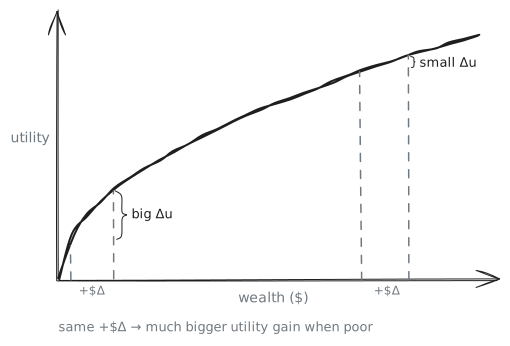
This is arguably the most important idea in understanding the world of finance. It is fundamentally why people don’t like risk and is so often the answer that lies at the bottom of the stack of whys.
We’ll also place ourselves in a simple, idealised world.2 The fundamental reason insurance is valuable has little to do with regulations mandating that all drivers buy car insurance. The world we’ll explore strips away all the complications of reality – regulation, taxes, frictions – so we can more easily get to the heart of the matter.
Why do people want insurance?
At its core, insurance is a product that moves money between states of the world. It takes money from states where your marginal utility of wealth is low – where you’re well-off and an extra dollar adds little to your life – and moves it to states where your marginal utility of wealth is high – where you’re in need and each dollar matters far more.
Although insurance isn’t giving you any money, it is giving you happiness. Most people intuitively understand this. You’re willing to pay an insurer a little bit of money for the peace of mind that if your house burns down, your family will still have somewhere to live.
The much more interesting question is how insurers can provide insurance profitably.
Why not just save instead?
The closest substitute for insurance is saving – setting money aside in anticipation of a rainy day. But saving is not a perfect substitute because it doesn’t allow you to transfer money between states of the world, only between time.
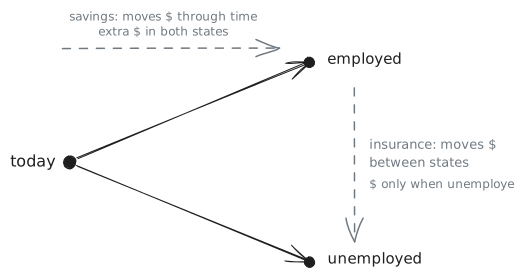
This means saving is less efficient than insurance. If you save money today in anticipation of unemployment tomorrow, you will also have this extra money in the ‘good’ state of the world, where you have a low marginal utility of wealth. Insurance allows you to move money only to the bad state of the world – where you have a high marginal utility of wealth. This is why for many risks, you’re often better off purchasing insurance rather than saving, as long as you’re getting it at a good price.3
Why are other people willing to supply insurance?
‘Profitably’ here is a loaded term. Consumers clearly gain utility from insurance at a low enough price. But the supplier must also gain utility at that price for a transaction to occur. There must be gains from trade – both sides have to be better off after transacting.
To investigate this we’re going to use an example of a village. It is a simple village – only a few people and everyone has the same utility curve. You can think of them as clones of one another – same wealth, same preferences, same attitude towards risk. The only thing that differs is what they do for a living.
There are also only two points in time – today and tomorrow. Today, everyone knows the probabilities of what might happen but not what will happen. Tomorrow, uncertainty resolves. This is the window in which insurance is useful – after you know the risks but before you know the outcome.
Let’s start by looking at a farmer.
The farmer
Our farmer produces and sells crops. But the value of his crops depends on the weather – if there is good weather, his farm does well and he makes $100,000. However there is a small chance of bad weather – and in this case, his farm is completely wiped out and he is worth nothing.
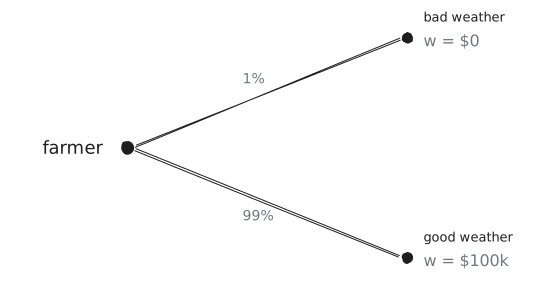
As of today, our farmer is actually relatively wealthy – his expected wealth is $99k:
$$E[w] = 0.01 \times 0 + 0.99 \times 100{,}000 = 99k$$Now, as we established above, the farmer can gain utility by moving money from the good weather state of the world to the bad weather state of the world, because he has diminishing marginal utility of wealth. If the weather is bad, his life is going to suck and he’s going to have to live very frugally to survive. By contrast, if the weather is good he is going to be rich, an additional dollar isn’t making his life significantly better. He will be overall happier today if he can smooth his consumption and transfer some money from the good weather state to bad weather state.
To transfer money between states, the farmer writes a contract with the following terms: if there is bad weather, the farmer receives $99,000. If there is good weather, the farmer pays $1,000.
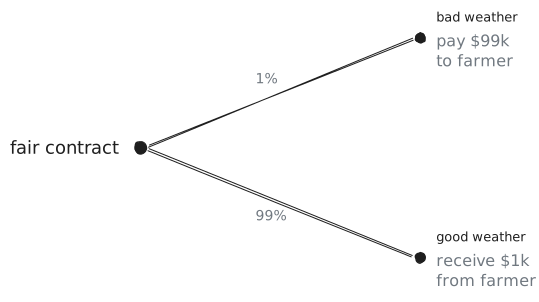
This is an actuarially fair contract – which means that the price of the contract is set at the cost of goods sold. The supplier is breaking even on this contract at this price, and as such its expected value is 0:
$$E[c] = 0.01 \times 99{,}000 + 0.99 \times (-1{,}000) = 0$$This contract allows the farmer to perfectly smooth consumption, his wealth is $99k in both states of the world with the contract, and his expected utility is higher because of it.
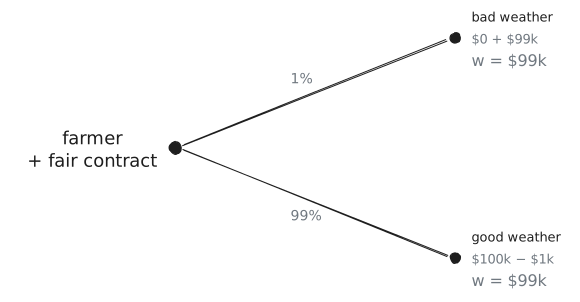
Now the question is, who would be willing to take the other side of this contract?
The blacksmith
The first class of people to consider is the general public. In this village, there is a blacksmith. He is as wealthy as the farmer (expected wealth = $99k), but his wealth is unrelated to the weather – he makes $99k regardless.
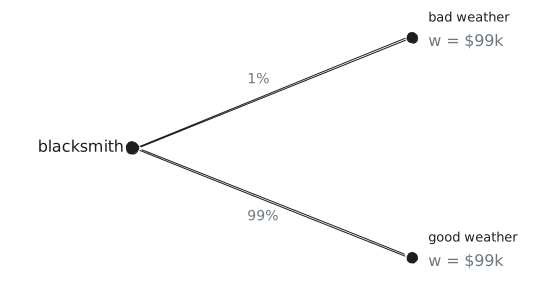
In this world, the blacksmith is not willing to supply the farmer’s contract. The contract does for the blacksmith the exact opposite of what it does for the farmer – it takes his already perfectly smooth consumption and introduces volatility, reducing his expected utility.
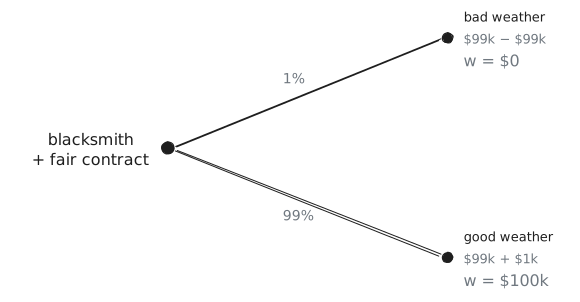
Even if the blacksmith accepts, nothing changes at the society level. The risk has just shifted to the blacksmith. Since they have identical utility curves, the farmer’s willingness to pay to offload risk is exactly equal to the blacksmith’s cost of bearing it. If the farmer would pay $1 to shed a unit of risk, the blacksmith would demand $1 to absorb it. There is no price the farmer could offer that would make both of them better off.
This is our first big insight – if we had to depend on ordinary people to supply insurance, very little would exist.4
The umbrella salesman
The second class of people to look at are natural hedgers.
Let’s say there is also an umbrella salesman in this village. He makes most of his money when there is bad weather. He has the same expected wealth as the farmer but the opposite distribution – he does well when the farmer does badly, and vice versa.
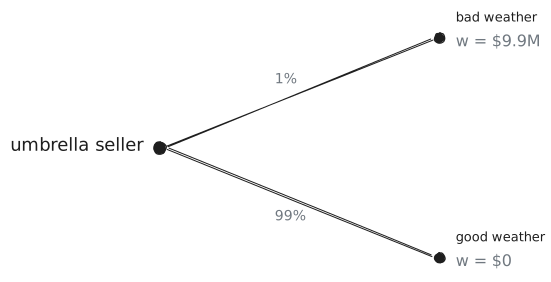
The umbrella salesman is willing to take the farmer’s contract because it smooths his consumption (marginally), making him better off without changing his wealth.
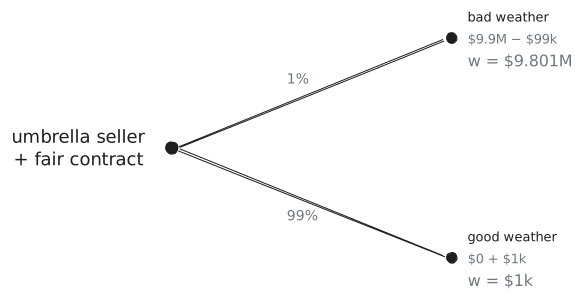
This is our second big insight – In markets with natural hedgers, you can match farmers and umbrella salesmen and reduce total risk, making society better off. You don’t need specialised insurance providers for supply.
This is why you don’t see much insurance for oil prices. There are enough natural hedgers on both sides of the market (companies who make money when oil prices are high and companies who make money when oil prices are low) that they can just trade oil contracts with each other and ‘insure’ themselves.
It’s hard to estimate how much natural hedging occurs globally, but OTC commodity derivatives alone – the contracts that let oil producers and airlines, wheat farmers and food companies, trade risks with each other – total roughly $2.4T in outstanding contracts.5 And commodities are only a fraction of the larger derivatives market – FX derivatives, where exporters hedge against importers, stand at $155T.6 For reference, annual insurance premiums sit at about $7T a year.7
The issue with natural hedging is that it requires somebody else’s wealth to be inversely correlated with your own. But many situations we want to insure don’t have natural hedgers. No one is becoming richer if you die early, or if your house burns down. This is where professional insurers come in.
The insurer
Imagine our village unfortunately has no umbrella salesmen (natural hedgers) available. But our farmer still wants to protect against the possibility of having no money in case of bad weather – in fact he is willing to pay a markup over the breakeven price of his contract in hopes of getting someone else to take it. We’ll represent the price of the contract as \(p\), where \(p>\$1k\) (the breakeven price of the contract).
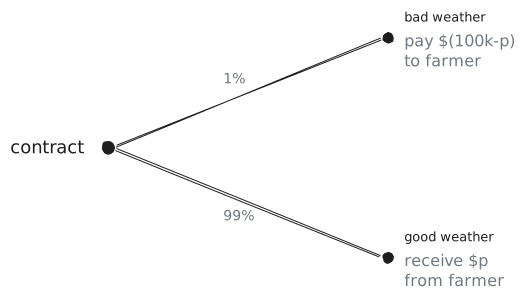
For the transaction to happen we still need there to be gains from trade. There must be a seller who also benefits from selling at this price \(p\). We’ve established that the blacksmith will never take the other side of this contract, because he has the same utility curve and level of wealth as the farmer. There is no price that would make both parties better off. But in a world where the blacksmith is wealthier, things change…
The insurer as the wealthy blacksmith
Imagine our blacksmith becomes very wealthy. His wealth is a million dollars, and it is again independent of the weather.
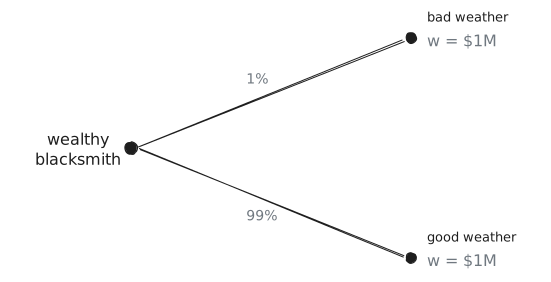
Now I claim that there is a price where both the farmer and wealthy blacksmith are willing to trade. What has changed? Even though the contract hasn’t eliminated any risk, this risk matters less to the blacksmith because he is richer. Let’s dive into this a bit more.
The farmer’s contract is, in essence, a bet. Consider a bet where you win $150k half the time and lose $100k the other half. Would you take it?
Your willingness to take this bet largely depends on how you weigh up two factors:
- On the plus side, this bet is a ‘good deal’ – you can expect to profit +$50k from taking it
- On the negative side, losing this bet is disproportionally bad compared to winning it because of diminishing marginal returns of utility, so this needs to be factored in too. Exactly how bad it is depends on how much losing $100k would affect your life and how risk averse you are as a person.
The richer you are, the more willing you are to take this bet, because losing $100k matters less to you. For someone with less wealth, losing $100k could mean becoming homeless, but for someone with millions, $100k is a drop in the bucket.
More generally, you can decompose the impact of any bet on your utility into two separate components:
- The utility from the expected value of the bet – represented by the first derivative of your utility curve
- The utility loss from the risk aversion – represented by the second derivative8
As you gain more wealth the utility loss from risk aversion becomes less significant. Economists refer to this finding as Decreasing Absolute Risk Aversion (DARA).9
This is the first of the two fundamental reasons why insurers exist. Insurers are far, far wealthier than their average customers. As such, the utility cost of bearing that risk is much lower for an insurer compared to an individual. That is why the wealthier blacksmith is now willing to insure the farmer. His cost of supplying the contract is being subsidised by wealth effects.
But wealth effects alone don’t scale – if the blacksmith supplies a thousand contracts, he is back to having a large risk relative to his wealth. The second piece of the insurance puzzle is risk pooling.
The insurer as the wealthy, risk-pooling blacksmith
Risk pooling is the secret sauce that allows insurers to supply insurance. Risk pooling refers to the fact that, if risks are independent, combining multiple risks reduces average portfolio volatility. Or more simply, if this wealthy blacksmith insures multiple farmers across different regions, he faces less risk per contract on average.
To illustrate this, let’s give this blacksmith, now a professional insurer, a choice. He can choose to insure one normal farm ($100k) or two small farms each producing $50k. Which would he choose?
The normal contract and farm is familiar. 99% chance of good weather (+$100k) and a 1% chance of bad weather ($0). Farmer pays \(p\) to insure the farm.
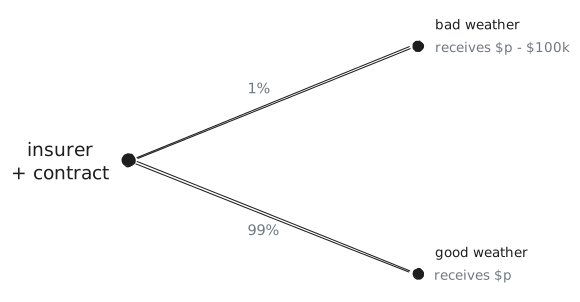
The two small farms face the same risk profile, but at half the amounts. 99% chance of good weather (+$50k) and a 1% chance of bad weather ($0). But their risks are independent – the fact that the weather is bad in one farm is unrelated to the weather in the other farm. Imagine the farms are located on opposite sides of the globe. Since each farm is smaller, the farmers only have to pay \(\frac{1}{2}p\) to insure it.
With two farmers, there are now three possible states of the world: both fail (\(0.01^2 = 0.01\%\)), exactly one fails (\(2 \times 0.01 \times 0.99 = 1.98\%\)), neither fails (\(0.99^2 = 98.01\%\)).
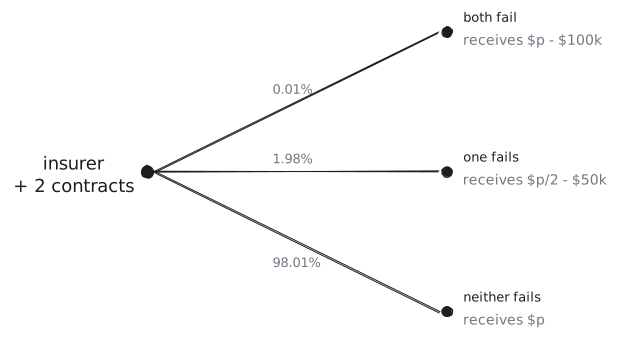
Both cases have the same average payout to the blacksmith – the blacksmith expects to make \(p\). But the risk profile is different in the case of the two small farmers. There is now this new middle state. Probability has flowed from the extremes into it: 0.99% from ’neither fails’ and 0.99% from ‘both fail’ have shifted to ‘one fails’.
Which does the blacksmith prefer? Let’s consider each of the shifts in turn. Moving probability from ’neither fails’ down to ‘one fails’ costs utility – the blacksmith is less likely to keep all his money. But moving probability up from ‘both fail’ to ‘one fails’ increases utility – he is less likely to face a full loss. Now the key part – because the blacksmith has diminishing marginal utility of wealth, the utility gain from reducing the probability of the worst outcomes outweighs the utility loss from reducing the probability of the best outcomes. Escaping the worst outcomes always matters more than losing the best ones. The blacksmith prefers to insure the two small, independent farms.
This is risk pooling – the magical mathematics that makes insurance work. Multiple independent contracts increase the probability of middle outcomes. Diminishing marginal utility means that escaping the worst outcomes is always worth more in utility than giving up the best ones. As you add more independent contracts, the distribution concentrates further – more middle states, fewer extreme ones – and the average risk per contract falls. Risk pooling reduces the amount of risk that the insurer bears.
This is part of the reason why you see few, large insurers rather than many small ones. Risk pooling creates natural economies of scale in the business of insurance, even in this idealised little village.
Note risk pooling is a fundamentally different mechanism from natural hedging. Natural hedging matches two counterparties with opposite risk exposures – it trades risk to cancel it out. Risk pooling reduces risk through the law of large numbers.
The key assumption that allows risk pooling to work is that the risks being insured are independent. What happens when they’re not?
Correlation and crashes
Independence means something specific. In our village, it means that knowing farmer A has bad weather gives us no new information about whether farmer B has had good or bad weather.10 In reality, this assumption is never strictly true. Even risks that are supposedly uncorrelated – for instance, two unrelated people dying – have a little correlation. There could be a bad flu season and suddenly many people die due to the same cause.
All insurers have the same goal – find risks that are as uncorrelated as possible and insure them. This is why you see lots of insurance offerings for relatively uncorrelated risks (travel, property, life insurance), and why all of these policies will specifically carve out correlated risks – situations that would lead to everybody claiming at once (war, floods, pandemics). If they had to cover these risks the prices they could offer would have to be much higher because they wouldn’t be able to get the benefits of risk pooling.
The key thing that insurers care about is risk per contract in their portfolio.11
The teal curve below displays the distribution of the return per contract. Watch what happens to it as the number of contracts grows. It narrows dramatically, and the range of likely outcomes per contract tightens. The static grey curve is the baseline risk per contract. Notice how most of the narrowing happens in the first 10–20 contracts. Adding more policies after that still helps, but with diminishing returns.
Now try dragging the correlation slider. Even a modest positive correlation – say 0.3 – requires many more contracts to get the benefits of risk pooling. And even with more contracts you still hit a hard limit in the risk you’re able to reduce – there’s a permanent irreducible risk (also known as \(\beta\) in finance). At a correlation of 1, adding more contracts has no effect on the portfolio return.
A fun aside – this is what caused the Great Financial Crisis in 2008. The financial sector was pricing portfolios of mortgages (CDOs) as if individual defaults were uncorrelated – assuming they were getting the full risk reduction of pooling. But the mortgages were far more correlated than they anticipated. When defaults arrived, they arrived together, precipitating the collapse of the financial system.
Closing
Insurance, like any other good, has a cost of production – but the cost isn’t timber or energy. It’s risk. Not all dollars are created equal, which is why people want to move them between states of the world. Specialised insurers can do this more cheaply than you can, through wealth effects and risk pooling.
All of this explanation has been done in our very simple village. If we drop these simplifying assumptions other reasons appear – imperfect information, transaction costs, taxes, regulation. But these are secondary, and can obfuscate that the fundamental thing happening is risk.
Customers are offloading risk, insurers are taking it on for a fee. That sentence wouldn’t have surprised you before reading this article. But hopefully you’re coming away with a much more visceral sense of what that means.
Strictly this finding is about diminishing marginal utility of consumption. To make this finding extrapolate to wealth, you need to assume that an individual is consuming all their wealth (i.e. not leaving inheritance to their kids etc.) ↩︎
The classic Modigliani-Miller idealised assumptions (complete markets, frictionless markets, symmetric information, equal market access, fixed investment policy) ↩︎
Precisely defining when you’re better off self-insuring requires introducing concepts like discount rates. This essay is already long enough as is. ↩︎
Even if we were to drop our simplifying assumption and allow people to have different utility curves – meaning some people have higher risk tolerances than others – there would still be very little insuring, because individual risk preferences don’t vary enough relative to the size of risks that need to be insured. ↩︎
BIS OTC derivatives statistics, Table D5.2 – Commodity Contracts, end-2024. Covers OTC commodity forwards, swaps, and options (gold, other precious metals, energy, and other commodities). ↩︎
BIS OTC derivatives statistics, Table D9 – by maturity, end-June 2025. Covers FX forwards, swaps, and options outstanding. ↩︎
Swiss Re Institute, sigma 3/2024, “World insurance: strengthening global resilience.” Global insurance premiums surpassed $7 trillion in 2023 and reached approximately $7.7 trillion in 2024. ↩︎
Risk aversion guarantees that this second derivative effect of a bet has a negative impact on your utility. Someone being risk averse is equivalent to saying that they have diminishing marginal utility of wealth. ↩︎
Given a smooth utility curve, you can use the Taylor-Series expansion to approximate the utility of a bet \(\Delta\) as:
$$U(w + \Delta) - U(w) \approx U'(w) \cdot \Delta + \tfrac{1}{2} U''(w) \cdot \Delta^2$$where \(U'(w)\) captures the EV effect, \(U''(w)\) captures the risk effect (negative if utility curve is concave), and \(\frac{-U''(w)}{U'(w)}\) is absolute risk aversion. Absolute risk aversion is defined this way because measures of utility are only useful if they are scale invariant. For most reasonable utility functions, \(U''\) decreases much faster than \(U'\), so absolute risk aversion falls with wealth. For example, with \(\ln(w)\): \(U'(w) = 1/w\) and \(U''(w) = -1/w^2\), giving \(A(w) = 1/w\). As wealth doubles, absolute risk aversion halves. This is DARA, which holds for most standard utility functions (log, power, etc.) but not all (e.g. exponential utility) – it is not guaranteed by concavity alone. ↩︎
Formally, two events \(A\) and \(B\) are independent if \(P(A \cap B) = P(A) \cdot P(B)\), or equivalently \(P(A \mid B) = P(A)\) – learning that \(A\) occurred tells you nothing about \(B\). ↩︎
Average variance per contract is a function of the base variance per contract \(\sigma^2\), the number of contracts being pooled \(n\), and the correlation between contract outcomes \(\rho\):
$$\sigma^2_{avg}=\frac{\sigma^2}{n}\left(1 + (n-1)\rho\right)$$ ↩︎